Osaka Stuns Sabalenka as Djokovic Breaks Federer's Wimbledon Record
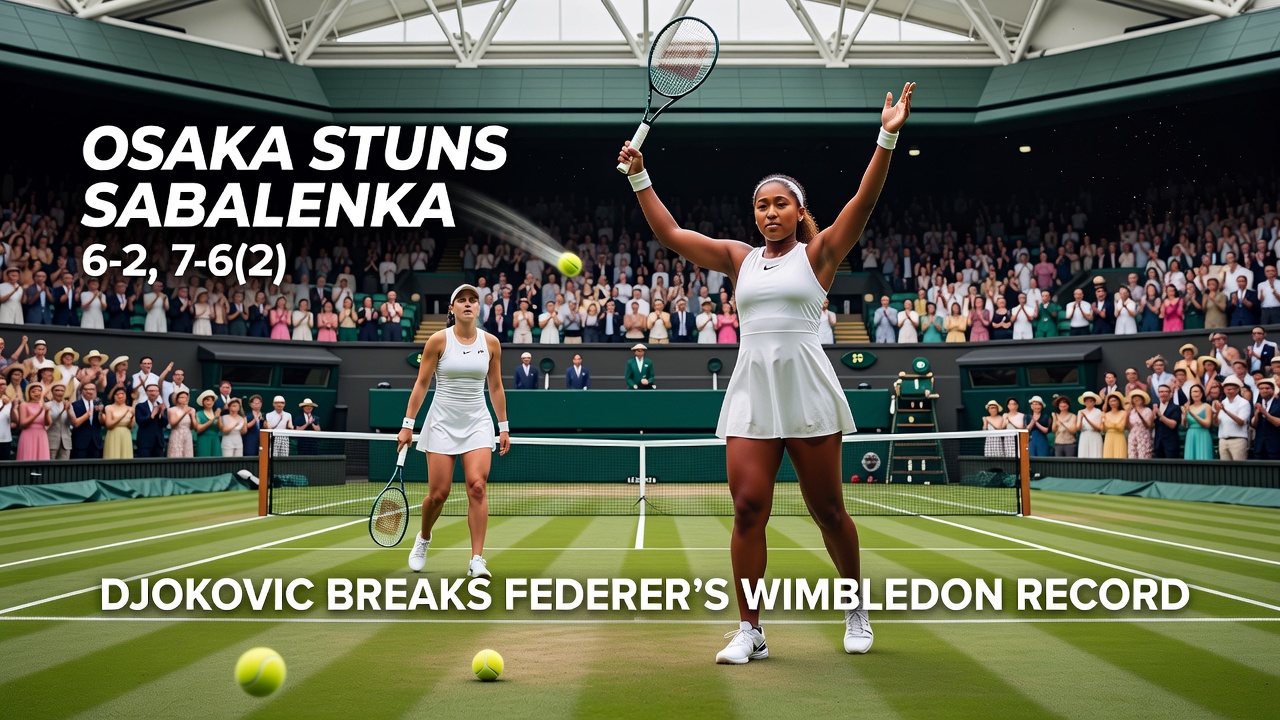
Day seven at Wimbledon delivered two of the tournament's most compelling storylines so far, as Naomi Osaka produced a dominant display to eliminate world number one Aryna Sabalenka, and Novak Djokovic surpassed Roger Federer's all-time singles victory record at the All England Club. The results set up a quarter-final week that promises to be among the most watchable in recent memory.
Osaka's 6-2, 7-6(2) victory over Sabalenka was a statement of the highest order. Beating the top seed at a Grand Slam is significant in any context, but this win carries particular weight because it marks the first time Osaka has reached the quarter-finals of a major outside of hardcourt. Her game - built on explosive serving and flat, heavy groundstrokes - has traditionally found harder surfaces more accommodating, making her progression on grass a genuine indicator of maturation in her overall game. The manner of the win, especially the commanding tiebreak in the second set, left little room for debate about the merit of the result. It is worth noting that the pace and precision Osaka brought to Centre Court was, at times, reminiscent of the kind of relentless rhythm one might associate with a slot playtech mechanism - mechanical, locked in, and utterly unforgiving to any lapse in attention from her opponent.
On the men's side, Djokovic's 7-6(6), 6-3, 3-6, 6-3 victory over Roman Safiullin was not without its complications. The Russian, who has shown consistent quality on the ATP Tour, made Djokovic work hard enough to take a set, and the opening set tiebreak went deep before the Serbian champion found a way through. But the broader context of the match will be remembered less for Safiullin's resistance and more for what the result meant in the record books: Djokovic's 106th singles win at Wimbledon moves him ahead of Roger Federer, who held that record as one of the most enduring benchmarks in the sport. For a man who has already claimed seven Wimbledon titles, adding a statistical crown that once belonged to Federer underlines the sheer longevity and consistency of Djokovic's career on this surface.
A Quarter-Final Draw Taking Shape
Osaka and Djokovic were not alone in advancing. Jessica Pegula and Karolina Muchova also secured victories on Sunday, strengthening a quarter-final line-up that spans a range of playing styles and competitive backgrounds. Pegula, the American number one, has been one of the most reliable performers on Tour in recent seasons, while Muchova's craft and variety on grass make her a dangerous opponent for anyone remaining in the draw. The convergence of these players in the last eight ensures that the second week at Wimbledon will not lack for narrative.
Osaka's Grass-Court Evolution
It would be reductive to frame Osaka's win purely as an upset. Her career, marked by four Grand Slam titles and stints away from the game, has taken a winding path, and her return to elite competition has been closely watched. Performing at this level on a surface historically less suited to her game suggests her preparation and physical condition have reached a strong place. Sabalenka arrived at Wimbledon as the world's top-ranked player and had been in formidable form entering the tournament, which makes the scoreline - particularly the 6-2 first set - all the more striking.
Djokovic Eyes Another Title Run
At 37, Djokovic continues to defy straightforward sporting logic. His ability to manage matches tactically, absorb pressure in tiebreaks, and recover from dropped sets without apparent disruption to his overall level is the product of decades of elite competition. With the Federer record now behind him, the focus returns to what it always does at Wimbledon for Djokovic: another title. Whether the rest of the draw can produce a genuine challenger to stop him reaching a final remains the central question of the men's competition as the second week begins.
(With inputs from agencies.)