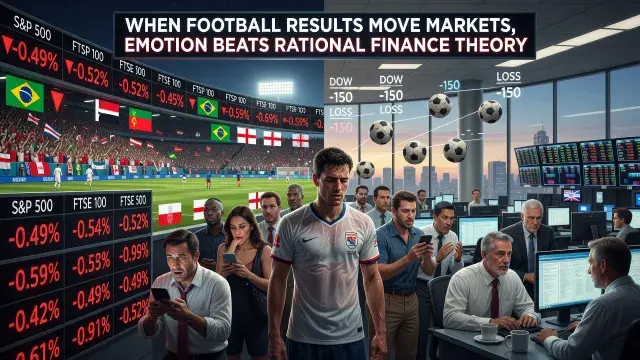
When Football Results Move Markets, Emotion Beats Rational Finance Theory
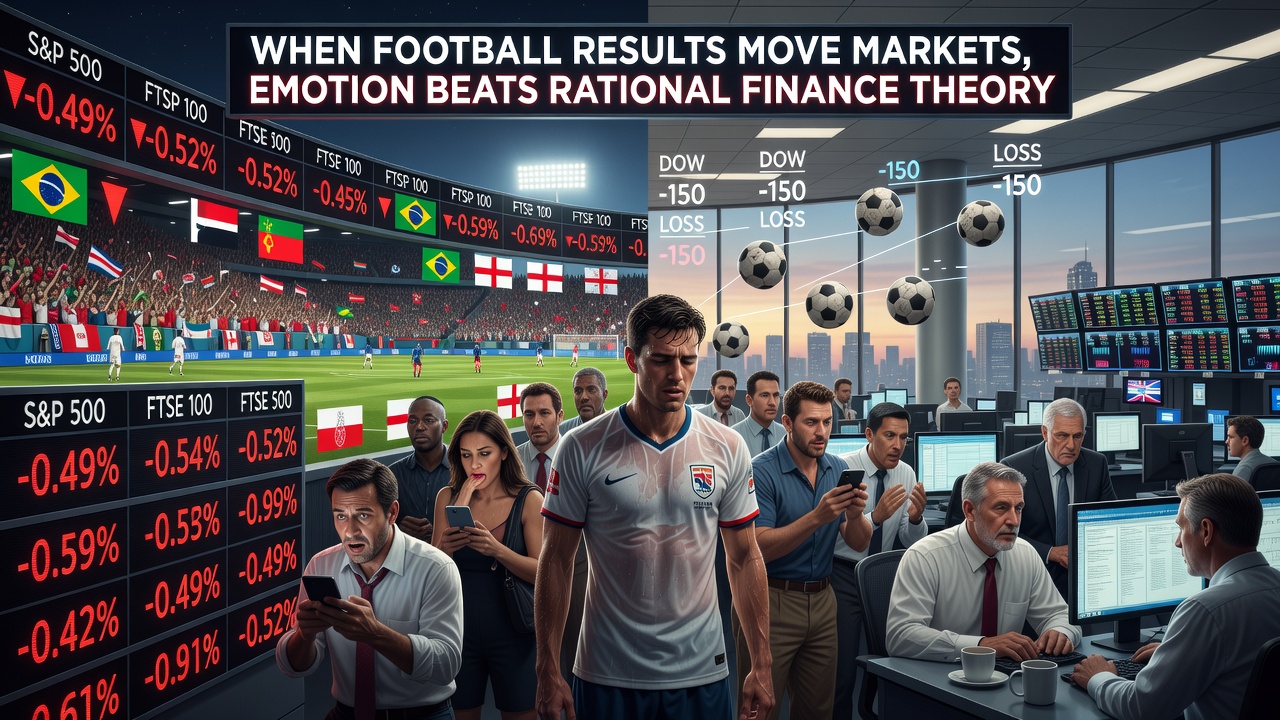
A landmark study in behavioural finance has long argued that stock markets are not the coldly rational machines that classical theory once assumed - and with another FIFA World Cup on the horizon, its central thesis feels more urgent than ever. Published in The Journal of Finance in 2007, Sports Sentiment and Stock Returns by London Business School Professor Alex Edmans, alongside co-authors Diego García and Øyvind Norli, demonstrated with rigorous statistical evidence that something as emotionally charged as a football result can move an entire country's financial market the following trading day.
The research drew on data from 1,162 international football matches played by national teams across dozens of countries over several decades - a dataset broad enough to reveal patterns that individual incidents could never confirm. For any reader who follows sport closely, the underlying instinct will feel familiar: the morning after a painful defeat carries a particular heaviness. What Edmans and his colleagues showed, however, is that this mood does not stay in the living room. It spills into the trading floor, quietly influencing how investors value assets. Much like how sports communities spanning from football to ha ndball register emotional swings after high-stakes results, financial markets appear to absorb and reflect collective sentiment in ways that rational models have consistently underestimated. Critically, the researchers controlled for all the conventional variables - global market performance, previous stock returns, day-of-the-week effects, and seasonal patterns - to isolate the emotional signal from market noise. ha
Losses Hit Harder Than Wins - and the Data Proves It
The study's most striking finding was not simply that football affected markets, but that the direction of that effect was heavily asymmetric. Defeats drove domestic stock markets down on the following trading day; victories, by contrast, produced little or no equivalent uplift. This reflects a well-established principle in behavioural psychology: losses loom larger than gains. Losing hurts more than winning feels good, and markets, it turns out, are not immune to that human tendency.
World Cup eliminations produced the most pronounced effect of all, which makes intuitive sense given the scale of emotional investment the tournament commands globally. The researchers found an average stock market decline of approximately 0.5 per cent in a losing nation on the next trading day following a World Cup exit. For a large economy with a deep capital market, that figure translates into billions in erased market value. The effect was also stronger in knockout-stage matches than in qualifiers, and more visible among smaller-cap stocks - instruments that tend to be held predominantly by domestic retail investors and are therefore more exposed to local sentiment shifts.
Why These Findings Matter More in Today's Markets
When the paper first appeared, mainstream finance was still broadly anchored in the efficient market hypothesis - the idea that prices reflect all available information and that investors, on the whole, behave rationally. The receptiveness Edmans encountered surprised even him. "People did realise that this was quite plausible," he has noted. "People were open to the fact that emotions drove markets, and they realised that this was an important study." Subsequent researchers went further, developing actual trading strategies built on the sentiment effect the paper had identified.
Edmans argues the paper's relevance has only grown since 2007, for two structural reasons. First, a growing share of today's most valuable companies derive their worth from intangibles - intellectual property, brand, and the perceived potential of technologies that do not yet generate stable cash flows - rather than from hard assets. When fundamentals are harder to pin down, sentiment fills the gap. Second, the profile of the average investor has shifted dramatically. The democratisation of trading through retail platforms has brought millions of emotionally engaged individuals into markets that were once dominated by institutional professionals. That combination - intangible-heavy companies and sentiment-driven retail investors - makes markets significantly more susceptible to mood swings of exactly the kind football can trigger.
What Investors Can Learn: Awareness, Discipline, and Patience
Edmans' new book, The Madness of Markets, opens with this study precisely because it illustrates a broader truth about how prices actually behave. If a football result can move a national stock market, then bubbles, crashes, manias, and hype cycles are not anomalies - they are predictable expressions of the same emotional architecture. The practical implication is not paralysis but awareness. Investors who understand that markets can fall without any deterioration in underlying economic fundamentals are less likely to panic-sell at the bottom or panic-buy at the peak.
The examples Edmans cites are instructive. During the Covid-19 market collapse, some investors bought aggressively as prices fell sharply, correctly identifying that sentiment rather than structural economic ruin was driving much of the decline. Clare College, Cambridge, invested £10 million into equities at the depths of the 2008 financial crisis, backed by a 40-year investment horizon and the discipline to hold course when emotion was screaming otherwise. The lesson is consistent: recognise when markets are overreacting, resist the pull of collective mood, and if the horizon allows, treat irrational dips as opportunities rather than warnings.